Signs of leaky ductwork in Little Rock, AR

A galvanized steel round duct with a 90-degree elbow and a white louvered vent cover on one end, shown against a plain gray background.
Get a local pro

Leaky ductwork usually shows up as rooms that never feel right. One bedroom stays warm in winter and stuffy in summer while the rest of the house is fine. Your energy bills climb even though you haven't changed how you run the system. You might notice the attic or crawlspace feels hotter or colder than it should, because that's where conditioned air is escaping before it ever reaches a vent. Dust building up fast around registers is another sign, since leaking ducts pull in unfiltered air from attics and crawlspaces and push it through the house. In Little Rock's long muggy summers and cold winters, a duct system working against a leak runs longer to hit the same temperature, and a gas furnace or central AC that runs longer uses more gas or more power to do it. None of this means the whole system is bad. It usually means a few seams, joints, or connections have come loose and need to be found and sealed.

Unfinished basement with concrete floor and walls, exposed wood joists, galvanized sheet-metal ductwork, a furnace unit, a steel support column, and a small window.
Sealed joints and solid metal runs move air straight to each room without losing it along the way.
Empty unfinished basement with bare concrete walls and floor, showing exposed wooden joists, galvanized sheet-metal ductwork, pipes, and a white vent grille overhead.
Loose flex connections and gaps at the joists let conditioned air escape before it ever reaches the vent.

Why does ductwork in this area leak in the first place?

  • Half the homes here were built by 1981

    Half the ductwork in Pulaski County sits in homes built in 1981 or earlier, old enough for joints and connections to have loosened over the years.

  • Heat runs November through March

    Five months of heat running November through March push warm air through every joint and seam, and any gap shows up as a cold room.

  • Cooling runs May through September

    Five months of cooling running May through September do the same job in reverse, so a leaky duct costs you twice a year, not once.

ACS 2020-2024 · NOAA nClimDiv 1991-2020

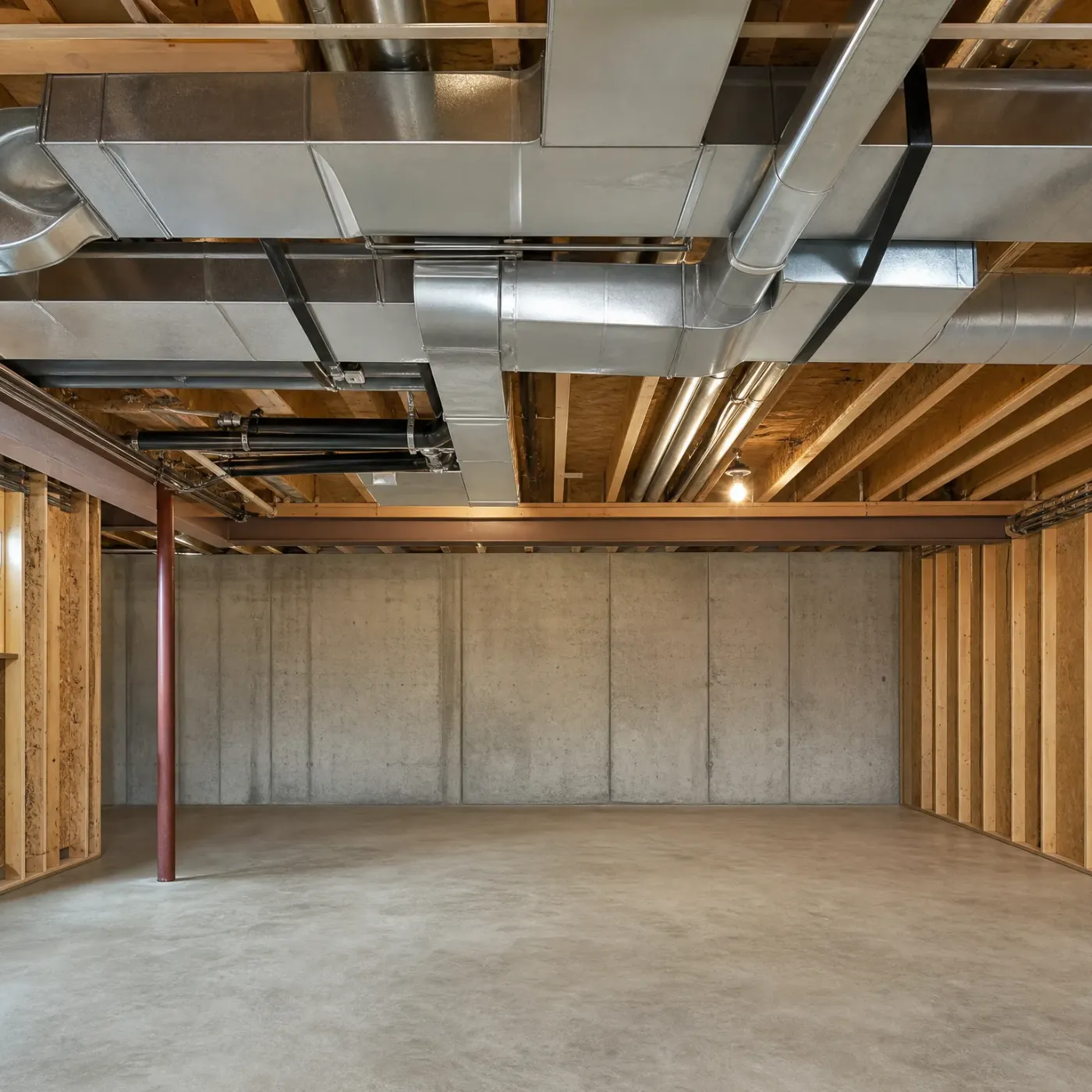
Empty unfinished basement with bare concrete floor and wall, wood-framed stud walls, exposed joists, galvanized HVAC ducts and pipes overhead, a steel beam and red support column, and a single bare bulb light.

Ductwork sealed and tight

This is what a basement run should look like. The metal boots are solid, the joints are sealed, and the flex connections sit snug against the joists. Air moving through here reaches the vents at full strength, so the system isn't working harder than it has to.
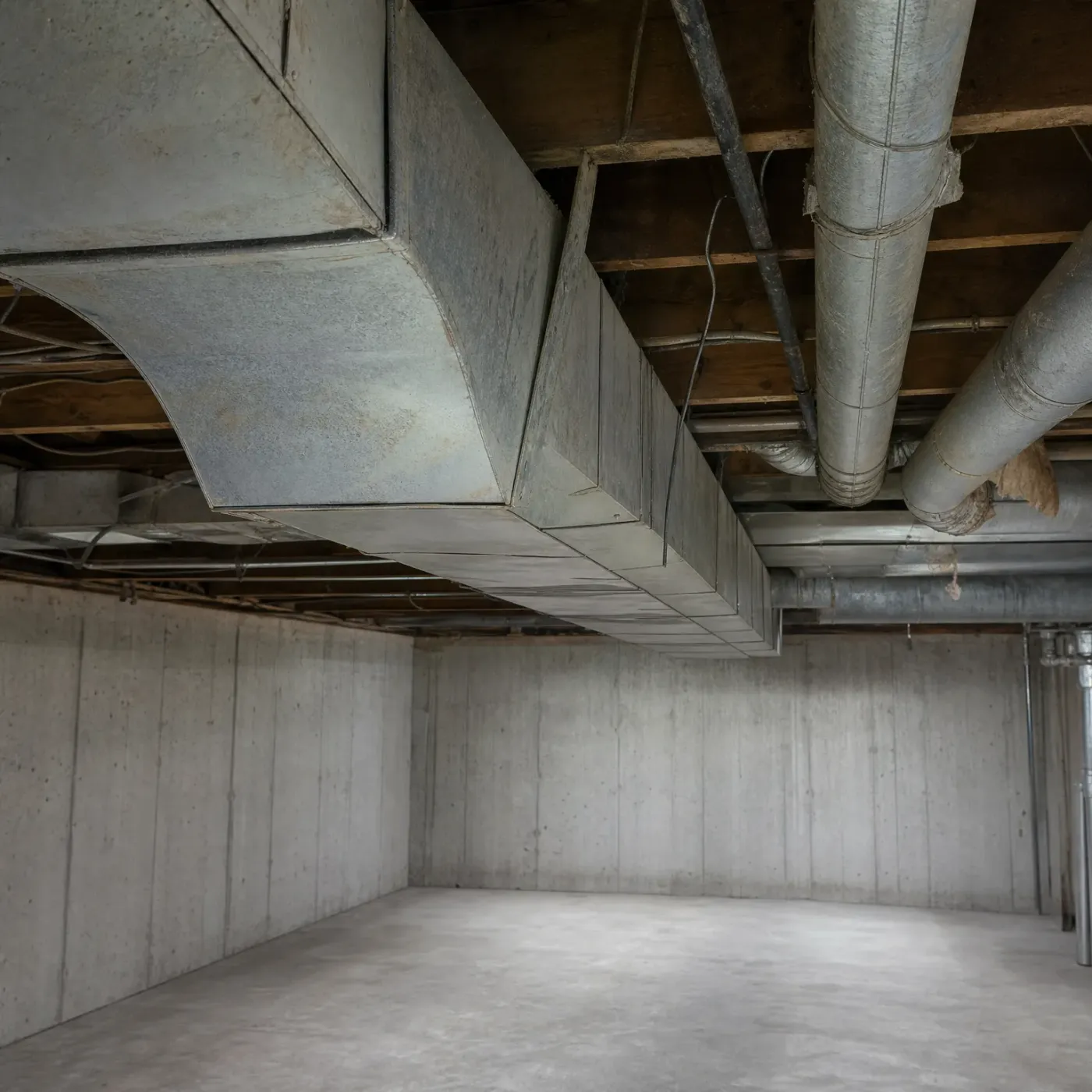
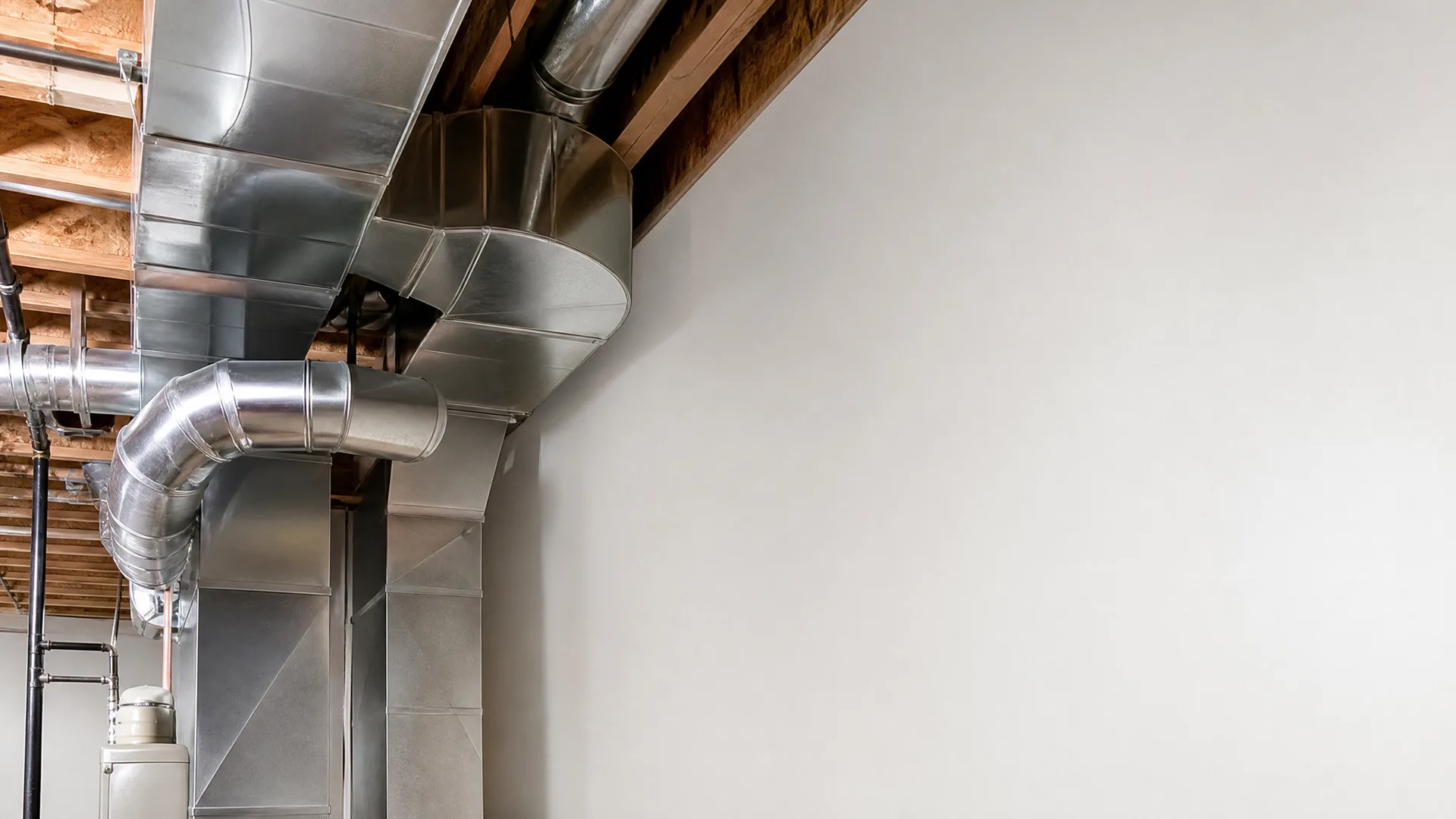
Empty concrete-walled basement with bare floor, showing large galvanized sheet-metal HVAC ducts, insulated pipes, wiring and wooden floor joists overhead.

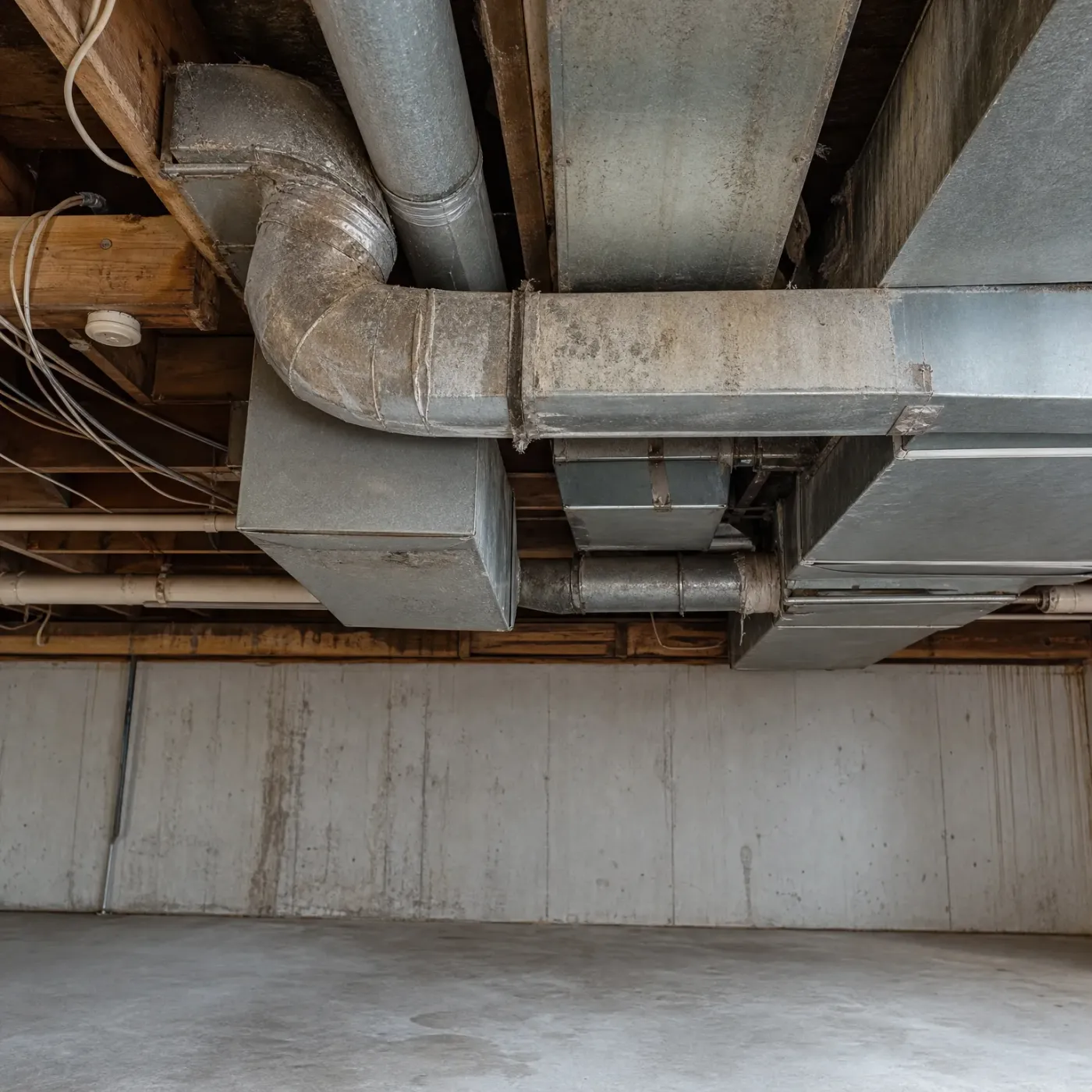
Ductwork losing air

Here the joints have come loose where the ducts meet the joists, and gaps have opened along the seams. Conditioned air is escaping into the basement instead of reaching the rooms upstairs, which is why a system in this shape runs longer to do the same job.

What You Notice vs What's Leaking

Leaks you can feel

  • A room that's hard to live in year round, warm in summer and cold in winter, points to ducts losing air before they reach that vent.
  • Vents that barely push air even on high usually mean the leak is close to the vent itself, where flex connections pull loose from years of flexing.
  • A hissing or whistling sound near a duct run, especially in the attic or under the house, is air escaping through a split seam.
  • Dust building up fast around registers or along baseboards near a duct run can mean the duct is pulling in attic or crawlspace air instead of delivering clean air.
  • A utility bill that keeps climbing while the thermostat setting stays the same often traces back to air the system is paying to condition twice.

What's really happening at the duct

  • Metal duct joints sealed with mastic or tape hold their seal for years, while connections only wrapped in old cloth tape tend to fail first.
  • Flex duct sagging between the joists forces air around a bend it wasn't designed to make, and the strain works connections loose over time.
  • A duct boot that was never sealed to the subfloor or drywall leaks straight into the attic or crawlspace, not into the room it's supposed to serve.
  • Static pressure from a leak forces the blower to work harder than it should, which shortens the life of the parts that move your air.
  • A return duct leak pulls in attic or crawlspace air and feeds it right back into the system, so the leak shows up in the air quality before it shows up on the bill.
Galvanized sheet metal HVAC ductwork and round pipes running along an exposed wood-joist basement ceiling beside a plain white wall.

Attic runs lose the most

Attic temperatures in Little Rock climb well past the air inside the duct itself during the summer months. A gap in a return run up there pulls in hot attic air and mixes it with the cooled air before it ever reaches a vent. That's why the room under the attic run is often the one that runs warm while the rest of the house holds steady.

Galvanized sheet metal HVAC ducts and round pipes installed among wooden joists on a ceiling, beside a large blank white wall.

Static pressure tells the story

A duct system that's sealed moves air at the pressure the blower was set to push. Once a joint opens up, part of that air bleeds off before it reaches the room, and the blower runs longer to move the same amount of air through the house. Gas furnaces here run five months straight, November through March, so that extra runtime adds up fast.

Why does my attic duct work hum or whistle sometimes?

You've heard it before, usually on a still night or when the system first kicks on: a faint whistle or hum coming from somewhere up in the attic. It's not loud enough to worry about at first, but it's steady, and it only happens when the air is running. You want to know if that sound means something is wrong with the ductwork up there or if it's just the system doing its job.

A whistle means air is escaping through a gap it shouldn't

That sound is air forcing its way through a small opening instead of flowing straight through the duct. A tear in the flex, a loose connection at a joist, or a boot that's pulled away all make the same kind of noise once air is moving fast enough through the gap. The hum tends to show up more in summer, when the system runs longer and attic temperatures in Little Rock push well past what's moving inside the duct, so the pressure difference across any gap is greater. A duct in good shape runs quiet because the air has nowhere to go but out the vent. If you hear it mainly near one run or one register, that's usually where the leak sits.

A woman in a gray turtleneck sweater stands near a window with snow outside, in a dimly lit living room with a lit Christmas tree, table lamp, sofa and bookshelf.
A woman in a cream knit sweater with her hair in a bun stands in a dimly lit living room looking out a large window at snow-covered evergreen trees, with a lamp, sofa, framed picture and lit candle behind her.
A woman in a thick gray knit sweater stands beside a window looking out at falling snow, with a dimly lit living room containing a lamp, sofa, string lights and a candle behind her.
A woman in a gray turtleneck sweater stands in a dimly lit room with a lit table lamp, framed picture and sofa, looking toward a window with snow outside.
  1. A joint or seam opens up in a supply or return run.

  2. Conditioned air escapes into the attic or crawl space.

  3. Static pressure drops, so less air reaches the register.

  4. The blower runs longer to push the same amount of air.

Galvanized sheet-metal ductwork and round pipes run beneath wooden floor joists in a basement with concrete walls and floor.
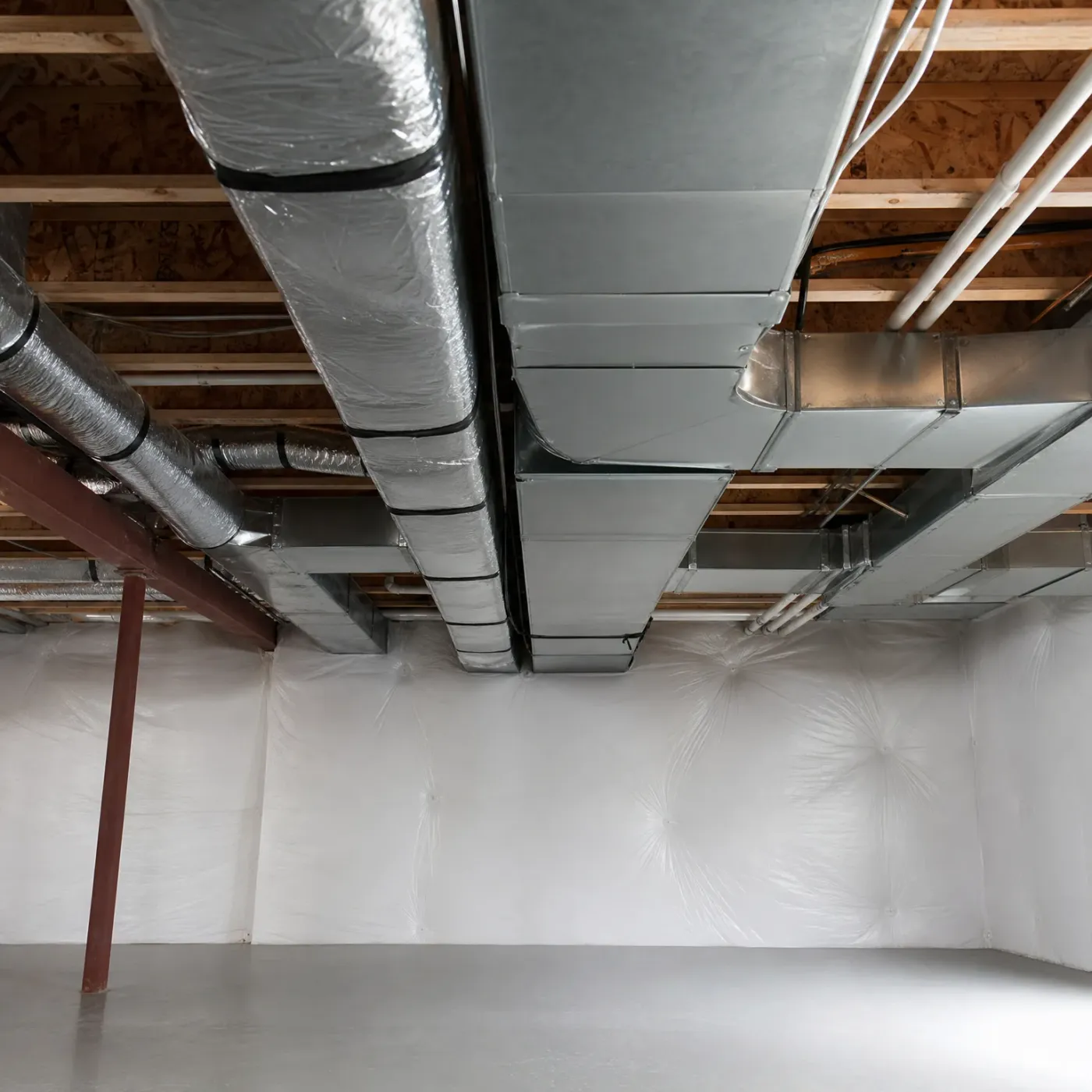
Before you get your ductwork cleaning
Unfinished basement with exposed wood joists, sheet metal and insulated flexible ductwork, white pipes, a steel support post, plastic-covered walls, and a bare concrete floor.
After you get your ductwork cleaning

Get matched with a duct system pro in Pulaski County

Send the form and finding a duct cleaner is handled.

It costs nothing to send, and you don't have to hire anyone.

What a leak is costing you now

A leak in your supply run means the blower has to push longer to get warm or cooled air to the rooms farthest from it. That longer runtime shows up on your power bill every month, not just in July or January. It also means the system logs more hours of wear on the blower motor than it would with sealed ducts. None of this shows up as a single event you'd notice. It shows up slowly, as a bill that creeps up and a system that seems to run more than it used to.

What it risks if it's ignored

A return leak in a crawl space or attic pulls in dust, insulation fibers and whatever else is sitting up there, and sends it through your system into the air you breathe. Over time that same leak can pull in enough moisture to leave a crawl space damp, which gives mold a place to start. The longer a leak sits unfixed, the more it can affect the condition of the ductwork around it, since moisture and loose joints tend to spread to the connections nearby.

Power here costs 13.15 cents per kilowatt-hour

At 13.15 cents per kilowatt-hour, every extra minute your blower runs to make up for lost air adds up fast on your bill. A leaky duct run doesn't just waste cooled or heated air, it makes the system work longer to replace it, and you pay for every one of those minutes.

EIA-861 2025

Catching it early versus letting it ride

Seal a leak when you first notice a room running warm or a bill creeping up, and the fix is usually a few joints and connections. The duct run itself is sound, it just needs the gaps closed. A contractor gets in, finds where the air is escaping, seals it, and the system goes back to moving air the way it was built to. The rooms even out. The blower stops working overtime. Nothing else in the system had time to suffer for it.

What changes if you wait

Leave the same leak alone through a few summers and winters in Pulaski County, and the blower motor has been running long hours the whole time to make up for lost air. That extra runtime wears on a motor that was sized for a sealed system, not a leaky one. The coil and the furnace's heat exchanger see more cycles too. What started as a sealing job can turn into a conversation about a motor that's worn out early, on top of the ductwork. The leak doesn't get better on its own, and neither does the strain on everything pushing air through it.

A bearded man in a red and dark plaid flannel shirt looks out a frost-edged window at a snow-covered yard, with a gray mug on the sill in the foreground.
A bearded man in a dark gray T-shirt sits smiling on a light gray couch, with a houseplant and a framed picture on the wall behind him.

What to do with these signs

  • A room that runs warm in summer and cold in winter almost always traces back to a leak somewhere in that run.
  • Rising bills with no change in how you use the system point to the blower working longer to cover lost air.
  • Weak airflow at a vent, a hum in the attic, or dust around a register are all signs worth checking before they get worse.
  • Most leaks in Pulaski County homes show up at loose joints and flex connections, not in the duct material itself.
  • Catching a leak early usually means sealing a joint or two instead of replacing a run.
  • Once you send the form, finding someone to look at it is off your plate.

A warm room in summer, a cold one in winter, a bill that keeps climbing, weak air at a vent, that's the list. None of it means the ductwork has to be torn out and replaced. In most homes around Pulaski County, the problem sits at a joint that's come loose or a flex connection that's slipped, not in the metal or the flex itself. That's a smaller job than people expect when they first notice the signs. The part that matters is catching it while it's still one or two spots instead of a whole run that's been losing air for years. A room that's run warm all summer tells a contractor something, a bill that's crept up over a few months tells them something else, and together they point to where to look first. You don't have to figure out which one it is or where the leak sits before you reach out. Send the form and that part of it, finding a contractor who knows this area's homes and knows where these leaks tend to show up, stops being something you have to sort out yourself. The signs you noticed are enough to start with. Someone who does this work can take it from there and tell you what they find, whether that's a joint that needs sealing or a run that's holding up fine and the issue is somewhere else. Either way, you're not the one chasing it down anymore.

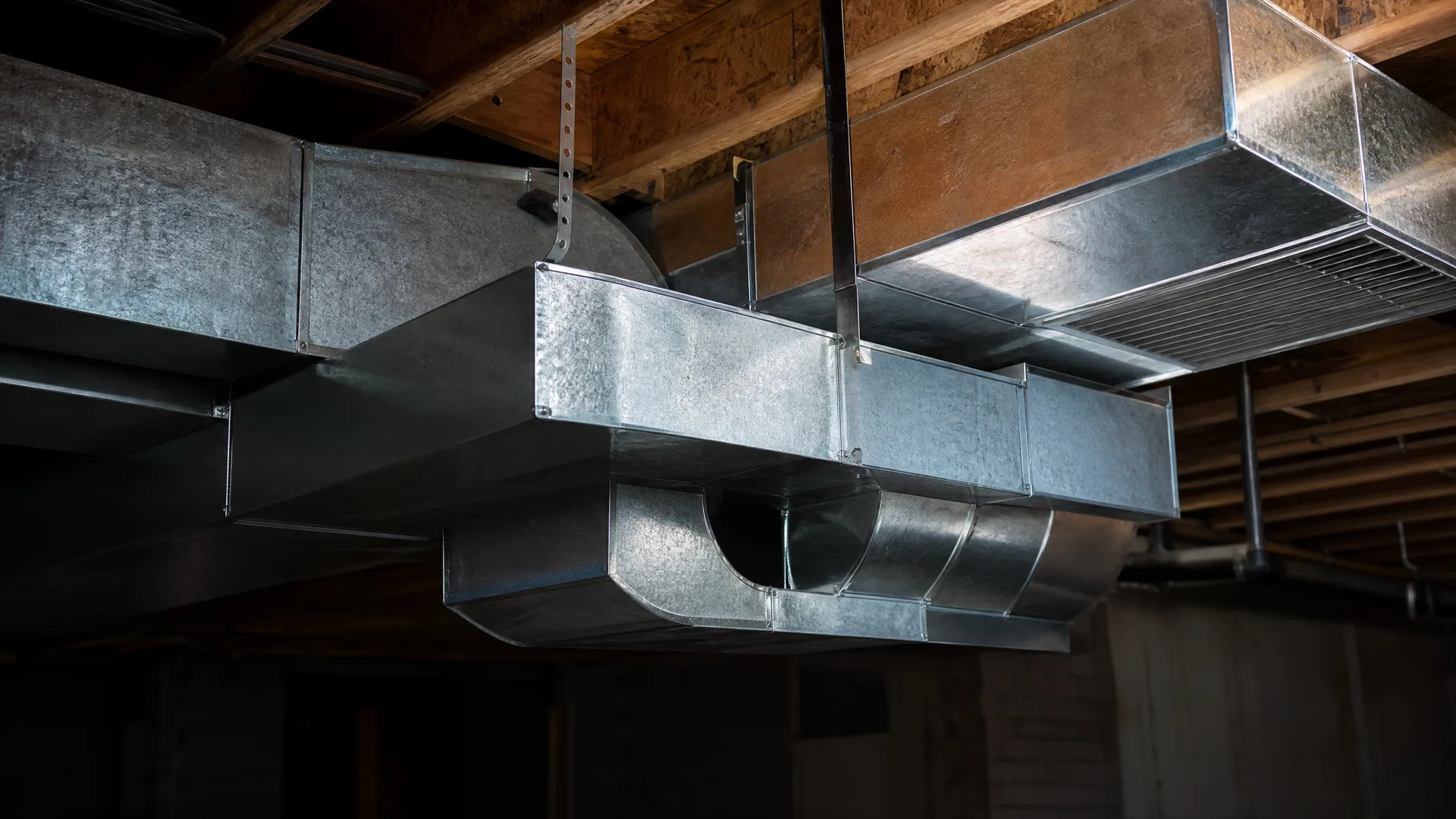
Galvanized sheet metal HVAC ductwork with rectangular trunks and round takeoffs suspended from wooden floor joists in an unfinished basement ceiling.

Find a duct system cleaning pro in Pulaski County

Duct and vent cleaningDucts or ventsPulaski County, AR
Step 1 of 2

What ZIP code is the job in?