Mini Split Installation in Malvern, AR
A new system here will heat from November through March and cool from May through September every year. Tell us about the house, and a licensed contractor who covers Hot Spring County will get in touch.
Tell us about the job
It takes about a minute.
Ten months a year of work for a Malvern mini-split
A mini-split here runs heat from November through March, then switches to cooling from May through September. That leaves only short stretches in spring and fall where it is not doing one job or the other.
Winter nights averaging 33°F keep the heat pump working through most of the cold months, not just on the rare freeze. Summer afternoons averaging 91°F mean the same system pulls that heat back out for five straight months. Any new mini-split has to meet 14.3 SEER2 for cooling and 7.5 HSPF2 for heating, the federal minimum for split-system heat pumps since January 2023.
- 5 months
- November through March, your system heats
- 5 months
- May through September, it cools
- 33°F
- the average winter night it heats against
- 91°F
- the average summer afternoon it cools against
NOAA nClimDiv, 1991–2020 normals
Arkansas requires HVAC contractors to hold a state license.
The license is issued to the contractor, not the job, so it travels with the business rather than resetting for every installation. Because Arkansas holds this licensing power at the state level, no county or city in Hot Spring County can layer on its own separate HVAC license requirement. The contractor who installs your mini-split is working under the same state license wherever in Arkansas the job happens.
For this installation, that state license is what stands behind the contractor's qualification to do the work. Beyond that, the mini-split still needs a permit from the local building office in most cities and counties, along with an inspection once the installation is finished. That inspection is a separate check on the completed work itself, apart from the license the contractor already holds.
Source: Arkansas Department of Labor and Licensing
- Is a mini split worth it?
- For most homes it is, especially if a room now runs on window units or electric baseboard. A mini split moves heat instead of generating it, so it gets more heat into the house per watt than electric resistance heat does, and most homes in Malvern still heat with electricity. Winters here average 33°F and summers reach 91°F, so the unit earns its place on the wall by running most of the year, not just a few weeks.
- How many rooms can a mini split cover?
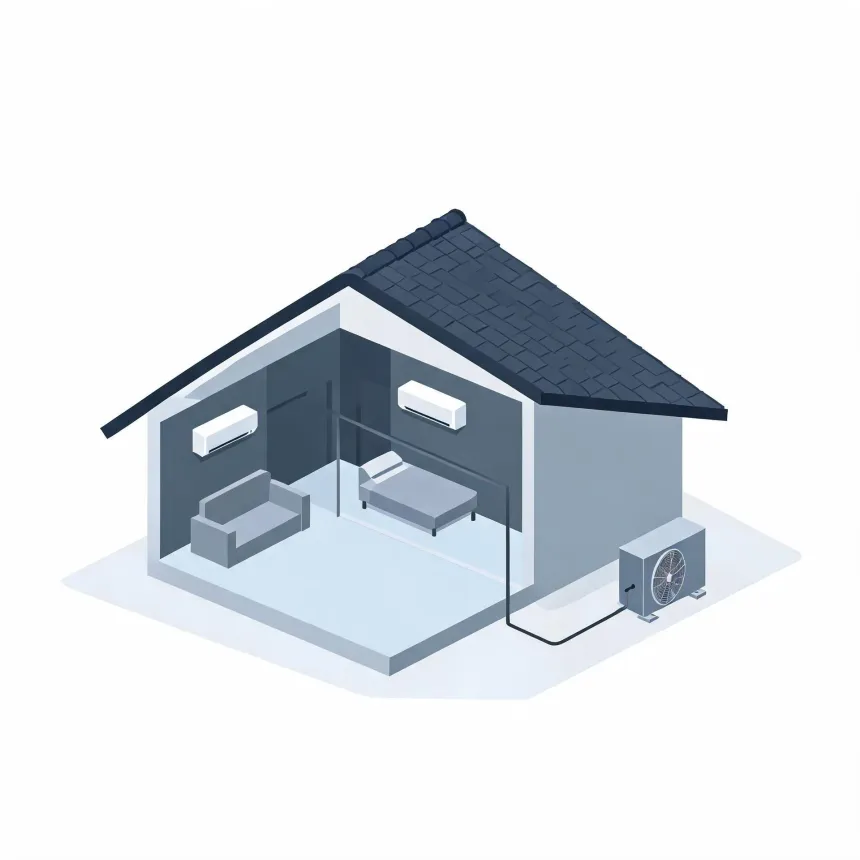
- A single outdoor unit can run one indoor head or several, depending on the system. Each indoor head is sized for the room it hangs in, so a small addition might run on two heads off one outdoor unit, while a house with more rooms needs either a larger multi-zone system or more than one outdoor unit. A contractor will look at the square footage and layout of the house and size it from there.
- Can a mini split heat a whole house?
- Yes, if it is sized and placed for the whole house rather than added to just one room. That takes enough indoor heads to reach every room, an outdoor unit sized for the total load, and a layout that accounts for open floor plans versus closed-off rooms. Winter nights in Malvern average 33°F, so the system also needs to keep producing heat at that temperature, which not every heat pump does well. A contractor can size this against the actual house.