
Mini Split Installation in Little Rock, AR
A new system here will heat from November through March and cool from May through September every year. Tell us about the house, and a licensed contractor who covers Pulaski County will get in touch.
Tell us about the job
It takes about a minute.
Ten months of work in Pulaski County
A mini-split here doesn't get much rest. Homes need heat from November through March, when winter nights average 33°F, then need cooling from May through September, when summer afternoons average 91°F. That's ten months out of twelve where the system is the thing keeping the house at the right temperature.
Any mini-split installed new has to clear the federal minimum. That's 14.3 SEER2 for cooling and 7.5 HSPF2 for heating, whether the home is adding a mini-split or replacing one. It's the floor every unit sold today has to meet, not an upgrade you pay extra for.
- 5 months
- November through March, your system heats
- 5 months
- May through September, it cools
- 33°F
- the average winter night it heats against
- 91°F
- the average summer afternoon it cools against
NOAA nClimDiv, 1991–2020 normals
Arkansas requires HVAC contractors to hold a state license.
The license is issued and tracked by the state, and it belongs to the contractor, not to any single job. That means the same license has to cover this mini-split install just as it would any other HVAC work the contractor takes on. Arkansas doesn't let Pulaski County or any city add its own license requirement on top, so the state's is the one that applies here.
Because the contractor is licensed, that's what stands behind the work itself. In most cities and counties, an installation like this also needs a permit from the local building office along with an inspection once the work is finished. That inspection is separate from the license. It's the local check that the install was done right, not a state record on the contractor.
Source: Arkansas Department of Labor and Licensing
- Is a mini split worth it?
- For the right room, yes. A mini split gives you heat down into cold winter nights and cooling through summer afternoons here without adding ductwork, and each indoor head runs on its own thermostat so you are not conditioning space nobody is using. It earns its keep fastest in a room your main system cannot reach well, or a house that heats with something other than a central system. Where it makes less sense is a home already evenly heated and cooled by ducts that work fine.
- How many rooms can a mini split cover?
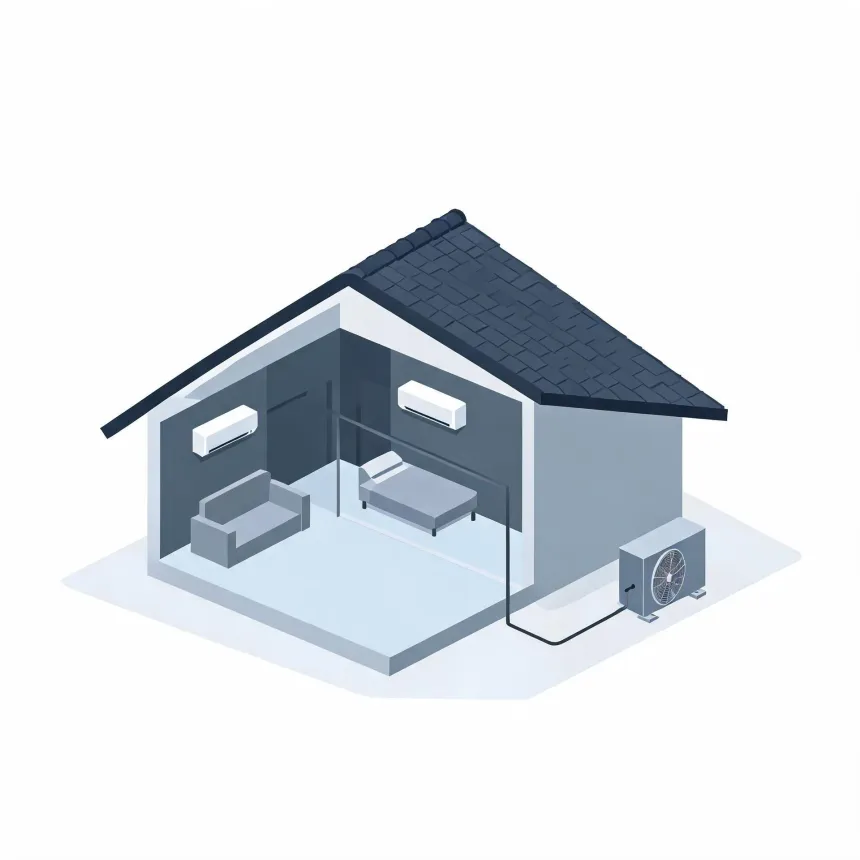
- One outdoor unit can run a single indoor head or several, depending on the system. Single-zone systems cover one room. Multi-zone systems split the outdoor unit's capacity across several rooms, each with its own indoor head and thermostat. The more zones you add to one outdoor unit, the more a contractor needs to size each head correctly, so this is a job for someone who will measure the rooms, not just count them.
- Can a mini split heat a whole house?
- It can, if it is sized and placed for that from the start. A multi-zone system with an indoor head in each room can carry a house through winter nights that average 33°F here, since these are heat pumps built to do both jobs. What decides whether it will actually work is layout. Rooms far from any head, or ones that do not get their own unit, will run colder than the rest. A contractor can look at the house and tell you whether whole-house coverage makes sense with mini splits alone or alongside what you already have.