Mini Split Installation in Harrison, AR
A new system here will heat from October through April and cool from June through September every year. Tell us about the house, and a licensed contractor who covers Boone County will get in touch.
Tell us about the job
It takes about a minute.
Eleven months of work, not four
In Harrison a mini-split works almost year round. Heat is needed October through April, seven months, with winter nights averaging 28°F from December through February. Cooling runs June through September, four more months, with afternoons averaging 87°F. Only one month sits idle.
A mini-split is a heat pump, so it has to hold up on both ends of that stretch, the cold nights and the hot afternoons alike. Any new one installed now has to clear the federal minimum for split-system heat pumps, 14.3 SEER2 for cooling and 7.5 HSPF2 for heating.
- 7 months
- October through April, your system heats
- 4 months
- June through September, it cools
- 28°F
- the average winter night it heats against
- 87°F
- the average summer afternoon it cools against
NOAA nClimDiv, 1991–2020 normals
Arkansas requires HVAC contractors to hold a state license.
Arkansas licenses HVAC contractors, and that license belongs to the contractor, not to this one job. It covers whoever holds it on every installation they do in the state, so the same license stands behind your mini-split as behind any other job they take on. Because the state holds this authority, counties and cities in Boone County are not allowed to add their own HVAC license on top of it.
For the mini-split installation itself, the license is not the only check. In most cities and counties, installing a mini-split needs a permit from the local building office, with an inspection once the work is done. That inspection looks at the physical work at your house, the wiring and the installation itself, separate from the contractor's license.
Source: Arkansas Department of Labor and Licensing
- Is a mini split worth it?
- For a lot of Harrison homes, yes. Heat is needed here October through April and cooling June through September, so the system is working 11 months of the year. A mini split handles both jobs with one system, and because it has no ducts, it does not lose heat or cool air the way ductwork running through an attic or crawlspace can. It also gives you a heat pump that keeps working down into cold weather, which matters when winter nights here average 28°F. Whether it is the right call for your house depends on how it is heated now and what rooms need coverage, and a contractor can walk through that with you.
- How many rooms can a mini split cover?
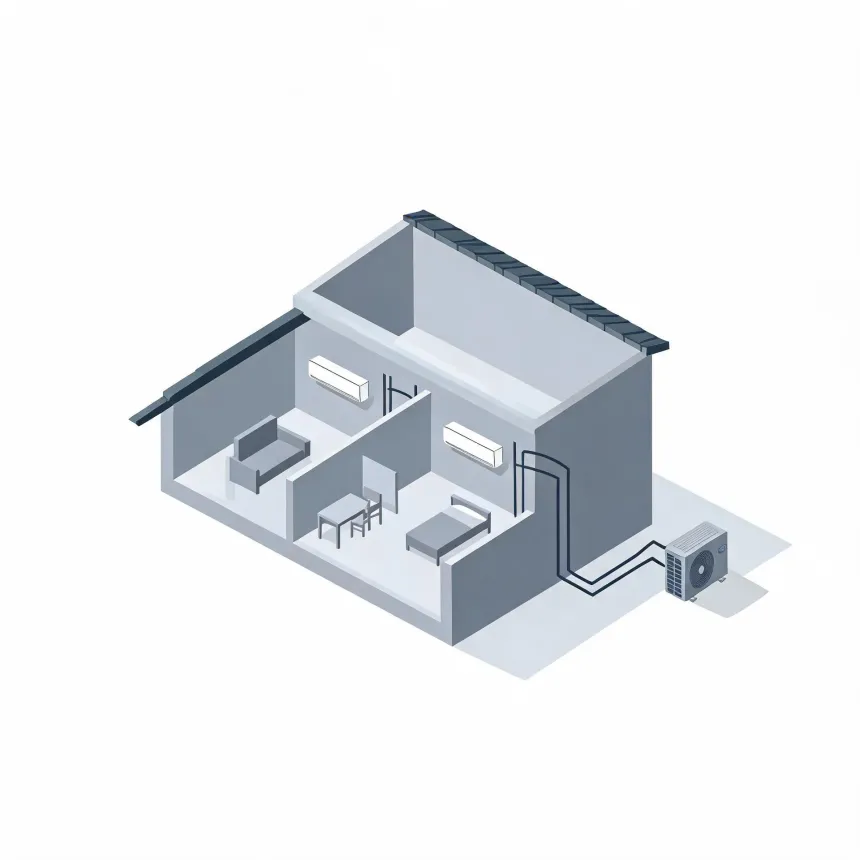
- A single outdoor unit can run one indoor head or several, depending on the system. A single-zone system covers one room or open area. A multi-zone system ties one outdoor unit to several indoor heads, each with its own thermostat, so you can heat or cool a few rooms independently. How many zones make sense for your house depends on the layout and how the rooms are used, which is something a contractor sizes room by room rather than guessing at.
- Can a mini split heat a whole house?
- It can, if it is sized and placed for that. A multi-zone mini split with enough indoor heads, one per room or area, can heat an entire house the same way a central system does, and as a heat pump it keeps producing heat even when Harrison nights drop to around 28°F in winter. What it cannot do is heat the whole house from a single indoor unit meant for one room. A contractor can figure out how many zones your house needs to get full coverage.